Verify the business and the review sources
The first job is making sure the feedback belongs to the right business, property, product or app. Similar names, duplicate listings and former trading names can produce misleading results. ReviewsBlender checks the relevant sources before analysis begins.
Record the analysis window, the channels included, the number of records available and important gaps. Collection depends on source availability, permissions and the agreed scope. A list of supported platforms does not mean every private record or historical review can always be retrieved.
See supported review platforms for the different customer, employee, software and app sources.
Keep the original context
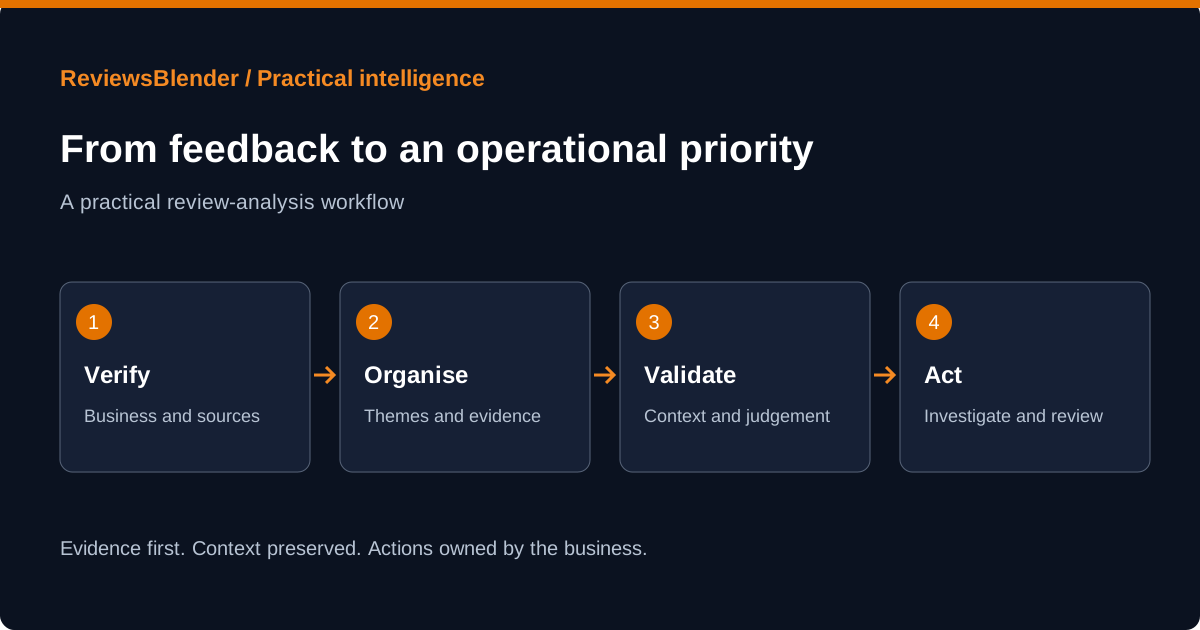
Keep source, publication date, rating scale, language and location alongside the review text. Where an experience date or app version is supplied, preserve that too. The day someone posted a review is not necessarily the day they visited or encountered the issue.
Check for duplicate text and cross-posting before claiming that separate records represent independent experiences. Retain the original-language text when creating a working translation. Public feedback is self-selected and may not represent the whole customer or employee population.
Separate themes, sentiment and hypotheses
| Layer | Example | What it establishes |
|---|---|---|
| Theme | The reviewer discusses waiting | The subject of the comment |
| Aspect sentiment | Food is praised; the wait is criticised | A mixed experience, not a single positive/negative label |
| Operational hypothesis | A peak-service bottleneck may be involved | Something to investigate using operational records |
| Action | Check order and staffing records for the relevant services | A next step, not a proved diagnosis |
One review may contain several themes. A theme mention rate should count unique reviews mentioning that theme and name the denominator. If 12 of 80 text reviews mention queues, the rate is 15% of those text reviews. It is not 15% of every customer who visited.
Use AI with a human validation layer
AI helps organise large amounts of text, identify possible patterns and draft summaries. Human review checks whether the interpretation follows from the feedback and whether it is useful in the business context. Particular care is needed with sarcasm, ambiguous wording, translations and sensitive allegations.
A small set of labelled examples helps keep categories consistent. Review disagreements rather than forcing every record into a confident label. We do not publish a universal AI accuracy percentage: performance depends on the language, subject, definitions and evaluation set.
Prioritise and follow through
Rank issues using evidence, potential impact and what the operator can reasonably change. Separate strengths worth protecting from concerns that need investigation. Explain uncertainty where feedback is sparse or contradictory.
Follow-up should compare suitable periods and record concurrent changes. Reviews can reveal useful signals, but they do not alone establish that an employee, shift or process caused an outcome. Private healthcare or employee data needs an agreed handling arrangement before it is shared.
See the example report and priority-matrix guide for the practical output.
Frequently asked questions
How many reviews are enough?
There is no universal minimum that makes every claim reliable. A small set can identify individual concerns; recurring-theme comparisons need sufficient relevant feedback in each group. We check suitability before analysis.
Can an AI analysis prove that a review is fake?
No. Unusual patterns can justify closer examination or a platform report. Text analysis alone does not establish authenticity, and the platform decides whether its rules have been breached.
Sources and further reading
- ReviewsBlender example operations intelligence report
- ICO: data protection and monitoring workers
- About ReviewsBlender and editorial standards
External product and policy information checked on 1 November 2026. Product descriptions are vendor documentation; recommendations and interpretations are ReviewsBlender’s. Linked policies take precedence if they change.
Find out what your reviews are telling you
ReviewsBlender produces a human-validated intelligence report for $99 one-off, delivered within 24–72 hours. Ongoing monitoring costs $59/month and delivers weekly intelligence reports with review response suggestions. Coverage is checked for your business before analysis begins.
No setup fees. Cancel monthly monitoring any time. At least 3 actionable insights in your report, or a refund.