Connect themes without combining incompatible scores
Customer reviews might describe long waits. Employees might describe unpredictable cover. App users might describe failed bookings. These are different experiences, but together they can suggest where an operator should investigate a service journey.
Do not average employer ratings, app ratings and guest scores into one unexplained number. Preserve the audience, platform, period, rating scale and count. A combined report can organise evidence around a shared problem without pretending every record measures the same thing.
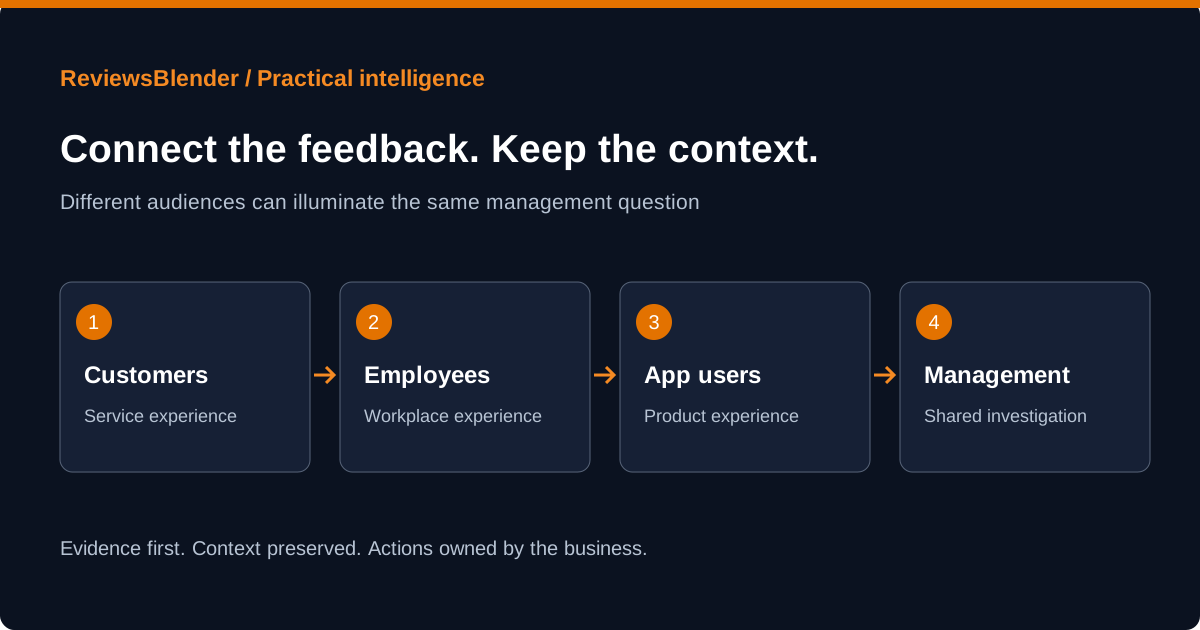
Use a shared question and source-specific categories
| Management question | Customer signal | Employee/app signal | Next check |
|---|---|---|---|
| Why are bookings failing? | Customers cannot confirm a booking | App users report confirmation errors | Test the booking journey and inspect failure records |
| Why are peak waits recurring? | Guests describe long queues | Employee feedback mentions cover pressure | Review comparable service periods and staffing evidence |
| Why is onboarding difficult? | Software customers describe confusing setup | Support themes identify repeated explanations | Observe setup and check documentation |
These are hypothetical connections. The table illustrates an investigation method, not evidence that a particular organisation has these problems.
Choose comparable windows and appropriate access
Use periods that make sense for the operational question. A review posted this month may concern an older visit; an employee review can describe a previous role. Record what is known and leave missing experience dates unknown.
Private employee and patient feedback require appropriate handling. Share only the minimum information needed for the purpose, limit access and avoid matching records to identify anonymous contributors. A public review is not unrestricted permission to create a personal profile.
Distinguish corroboration from causation
Several sources describing a similar concern can strengthen the case to investigate. It does not establish that one source proves another. Workload feedback and customer queues may have several causes, and changes in collection can produce an apparent trend.
Ask management to test the proposed explanation using operational records, observation and appropriate staff/customer input. Record the action and its evaluation method rather than treating the first plausible explanation as a diagnosis.
Use one brief with clear source sections
A practical combined report starts with the management question, shows each source’s relevant themes and then identifies actions that need a shared owner. It should also retain strengths and evidence that does not fit the leading hypothesis.
ReviewsBlender’s service covers customer, employee, software and app feedback. Agree the relevant sources and scope before combining them. The coverage page and methodology explain the boundaries.
ReviewsBlender produces a human-validated intelligence report for $99 one-off, delivered within 24–72 hours. Ongoing monitoring costs $59/month and delivers weekly intelligence reports with review response suggestions. Coverage is checked for your business before analysis begins.
Frequently asked questions
Should all feedback go into one sentiment score?
A shared taxonomy can help organise themes, but different populations and scales should remain visible. A single unexplained composite can conceal important differences.
Can combined feedback establish who caused a problem?
No. It identifies questions for investigation. Operational evidence and an appropriate fair process are still needed.
Sources and further reading
- ICO: data protection and monitoring workers
- Acas: fair workplace investigations
- About ReviewsBlender and editorial standards
External product and policy information checked on 1 November 2026. Product descriptions are vendor documentation; recommendations and interpretations are ReviewsBlender’s. Linked policies take precedence if they change.
Find out what your reviews are telling you
ReviewsBlender produces a human-validated intelligence report for $99 one-off, delivered within 24–72 hours. Ongoing monitoring costs $59/month and delivers weekly intelligence reports with review response suggestions. Coverage is checked for your business before analysis begins.
No setup fees. Cancel monthly monitoring any time. At least 3 actionable insights in your report, or a refund.