Separate urgency from frequency
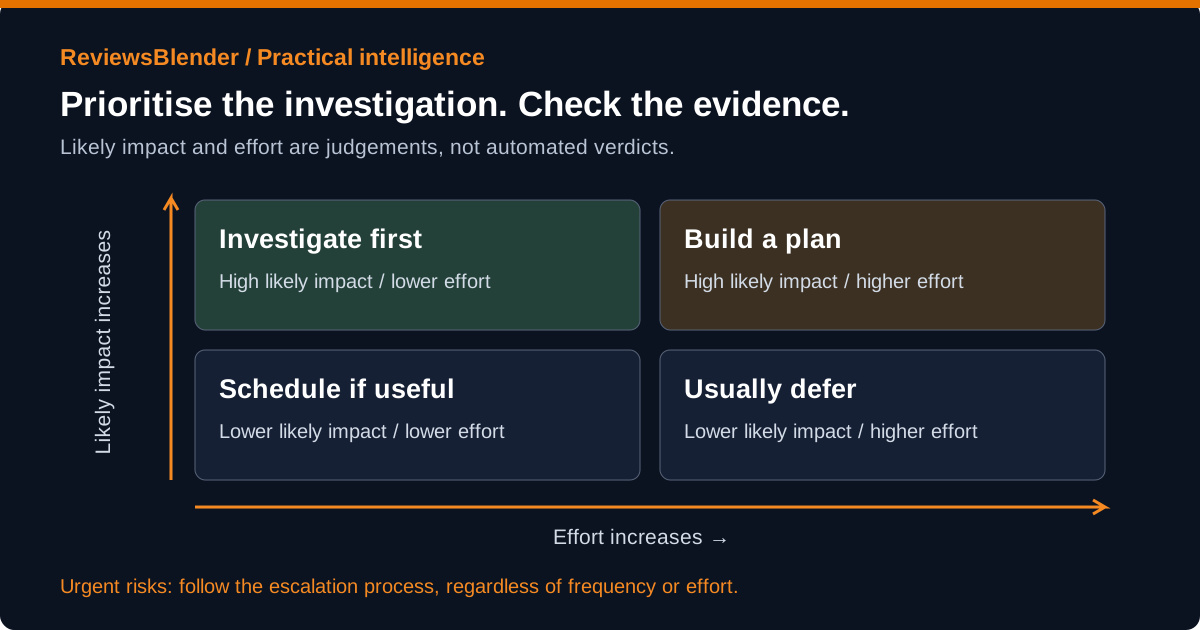
A frequent minor inconvenience and an isolated serious concern require different decisions. Safety, safeguarding, privacy or potential harm should follow the relevant escalation process promptly, regardless of the size of the review cluster.
For routine improvement work, look at frequency alongside the strength of evidence, consequence for customers, effort and what the business can control. Do not treat a numerical score as a substitute for judgement.
Use a simple priority matrix
| Factor | Useful question |
|---|---|
| Evidence | Is the issue directly supported, inferred or uncertain? |
| Frequency | How many relevant reviews mention it, out of how many? |
| Impact | What does the concern mean for customers and operations? |
| Effort | What would investigation and a practical change require? |
| Control | Can this team act, or is another organisation responsible? |
| Verification | How will we assess whether the action helped? |
A worked example: repeated waiting complaints
Imagine 12 of 80 text reviews mention waiting, with some referring to paying the bill and others to food arrival. Split the journeys before recommending one solution. These invented figures illustrate the method.
For billing delays, an appropriate next step might be observing payment during a busy service. For food arrival, inspect order timing and kitchen handovers. The feedback identifies the investigation; it does not establish that the team needs more staff.
Write actions that can be owned
| Weak action | More useful next step |
|---|---|
| Improve service | Duty manager to observe payment requests during two comparable services and report the bottleneck |
| Train staff | Identify the specific communication gap, agree the required behaviour and check whether it is followed |
| Fix the app | Product owner to reproduce the reported redemption problem and compare affected versions |
| Improve cleanliness | Review inspection records for the described areas and check whether the issue recurs |
Examples are illustrative. An action should reflect what has actually been investigated and authorised. Public responses should not claim a change has already happened simply because it appears in an action plan.
Review the result without overstating causation
Keep a change log and compare suitable periods. Check theme counts, review volumes, relevant operational measures and any changes in platform mix. A small increase or decrease can be noise when there are few reviews.
The example report includes a priority matrix and three actions for the week. Its value is helping management start a focused conversation, then check what the evidence supports.
ReviewsBlender produces a human-validated intelligence report for $99 one-off, delivered within 24–72 hours. Ongoing monitoring costs $59/month and delivers weekly intelligence reports with review response suggestions. Coverage is checked for your business before analysis begins.
Frequently asked questions
Should we fix the most-mentioned problem first?
Not automatically. Consider risk, evidence, impact and control. A serious concern may need immediate escalation even if mentioned once.
Can a priority score predict revenue?
A prioritisation score is a decision aid. It is not a validated forecast of revenue unless a separate, defensible model establishes that relationship.
Sources and further reading
External product and policy information checked on 1 November 2026. Product descriptions are vendor documentation; recommendations and interpretations are ReviewsBlender’s. Linked policies take precedence if they change.
Find out what your reviews are telling you
ReviewsBlender produces a human-validated intelligence report for $99 one-off, delivered within 24–72 hours. Ongoing monitoring costs $59/month and delivers weekly intelligence reports with review response suggestions. Coverage is checked for your business before analysis begins.
No setup fees. Cancel monthly monitoring any time. At least 3 actionable insights in your report, or a refund.