The customer’s challenge
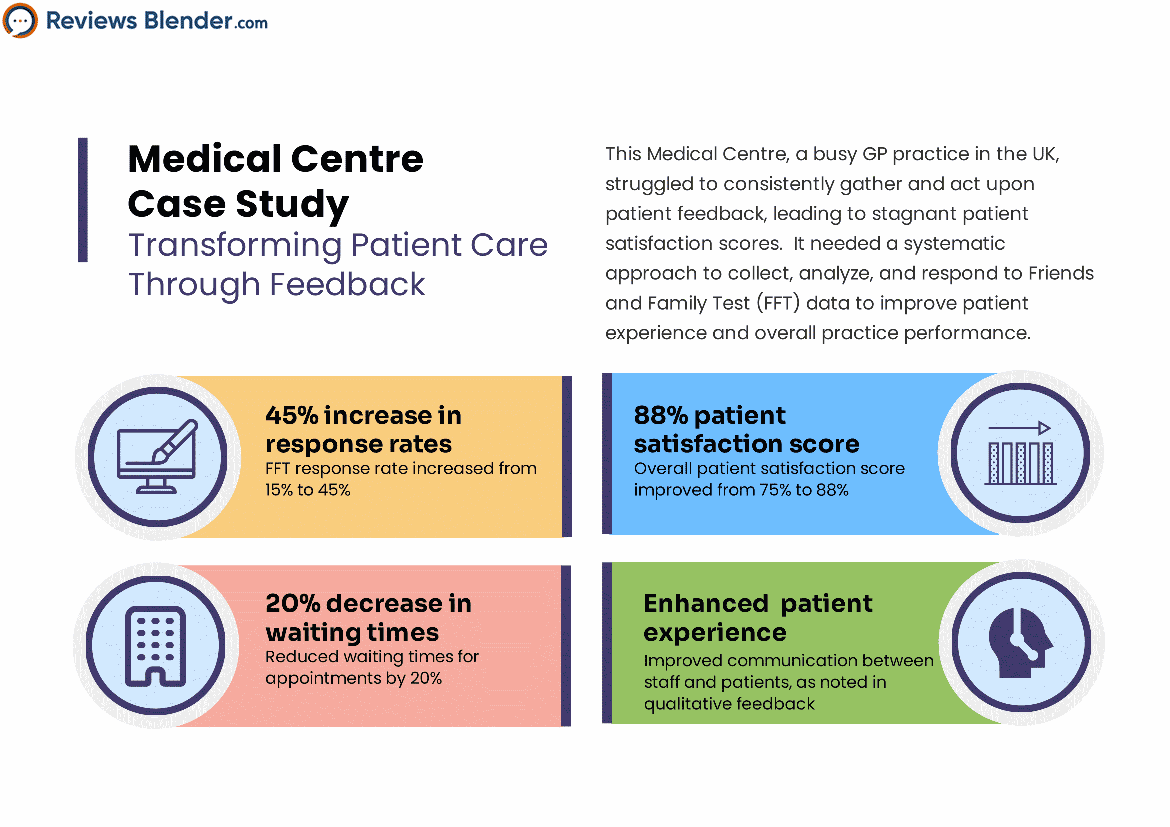
A busy UK GP practice wanted to gather and act on patient feedback more consistently. Its patient-satisfaction measures had stagnated, and it needed a systematic way to use Friends and Family Test feedback in service improvement.
The engagement used patient feedback to support a clearer improvement process. The published account describes changes in FFT participation, patient satisfaction and appointment waiting, alongside qualitative improvements in communication between staff and patients.
Reported outcomes
The response rate rose from 15% to 45%: a change of 30 percentage points. The satisfaction measure rose by 13 percentage points. The case graphic’s 45% response headline is the final response level, not the size of the percentage-point increase.
What the engagement illustrates
| Area | Practical lesson |
|---|---|
| Participation | Understand who is responding and whether collection changes affect the result. |
| Experience themes | Use comments to explain the parts of the patient journey requiring investigation. |
| Governance | Handle sensitive feedback through the provider’s appropriate confidentiality and escalation processes. |
The useful connection is between feedback, an investigation and a change the organisation can own. A summary makes those conversations more manageable; it does not remove the need to establish what happened in the underlying operation.
How to interpret the results
The existing case does not publish a complete dataset, a uniform measurement window for all measures or a controlled causal evaluation. The reported experience outcomes should not be treated as clinical effectiveness evidence, a national benchmark or a promise for another practice.
The original case material
Applying the learning to your organisation
A provider considering similar work should follow current NHS England FFT guidance, agree data handling before sharing records and assign responsibility for acting on themes. Public reporting should protect patients and staff while explaining the learning.
Inspect the example report to see the report structure, then use the methodology to understand source checks and the limits of inference. A good starting brief states the management question, relevant feedback and who will own the follow-up.
Frequently asked questions
Are these customer engagements?
Yes. ReviewsBlender has confirmed that these examples describe customer engagements. The outcomes and scope are based on the existing case material.
Will another business achieve the same result?
Results depend on the starting position, feedback, operational changes and other factors. The case is an example, not a performance guarantee.
Sources and further reading
- Original customer-engagement graphic
- About ReviewsBlender and editorial standards
- NHS England: Friends and Family Test

External product and policy information checked on 1 November 2026. Product descriptions are vendor documentation; recommendations and interpretations are ReviewsBlender’s. Linked policies take precedence if they change.
Find out what your reviews are telling you
ReviewsBlender produces a human-validated intelligence report for $99 one-off, delivered within 24–72 hours. Ongoing monitoring costs $59/month and delivers weekly intelligence reports with review response suggestions. Coverage is checked for your business before analysis begins.
No setup fees. Cancel monthly monitoring any time. At least 3 actionable insights in your report, or a refund.