The customer’s challenge
GreenTech Inc., an environmental technology business, wanted to improve talent attraction and employee retention. Its HR team recognised that employee feedback could help identify workplace themes worth investigating.
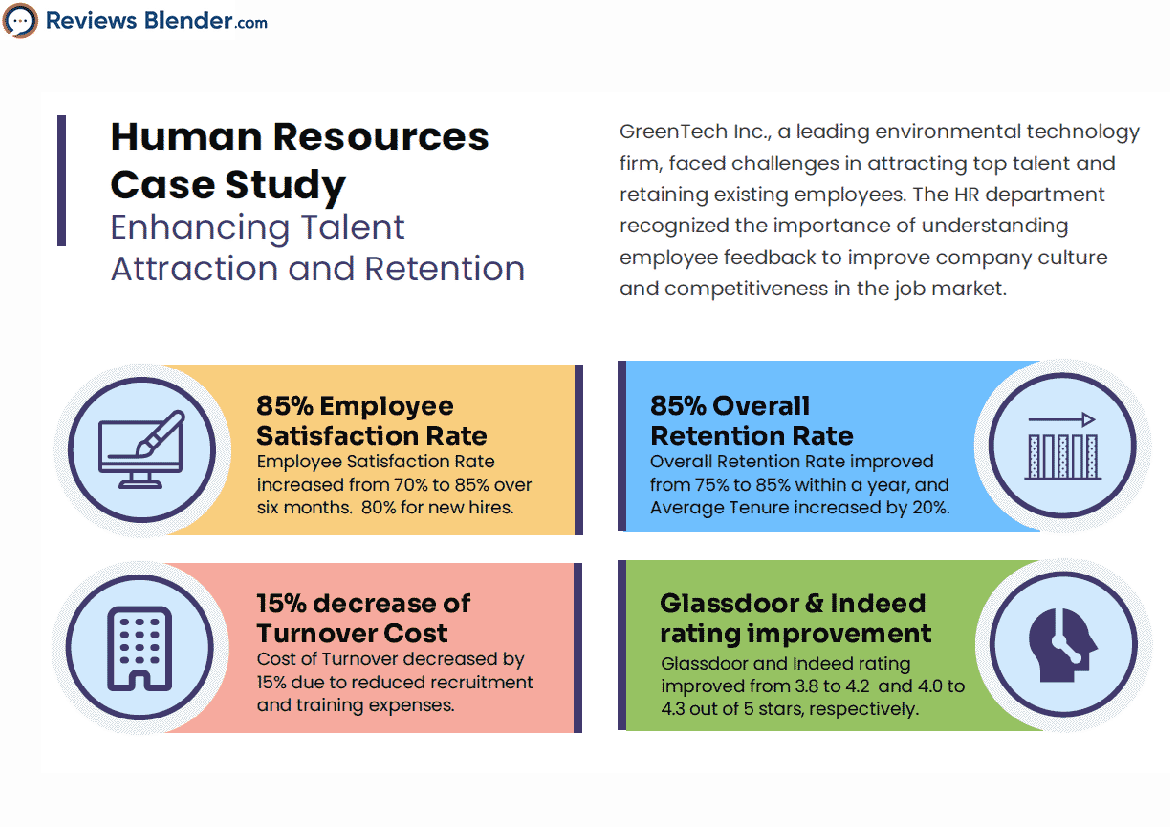
The engagement considered employee feedback as part of understanding the workplace experience and employer reputation. The existing case material reports changes in satisfaction, retention, tenure, turnover cost and Glassdoor/Indeed ratings.
Reported outcomes
The published account also records Glassdoor ratings moving from 3.8 to 4.2 and Indeed from 4.0 to 4.3. It gives an 80% satisfaction figure for new hires without an accompanying baseline. The changes above retain the distinct six-month and one-year periods stated in the source.
What the engagement illustrates
| Area | Practical lesson |
|---|---|
| Workplace themes | Look for recurring concerns without trying to identify anonymous reviewers. |
| Internal context | Compare themes with suitable aggregate HR measures and a fair investigation process. |
| Measurement | Keep definitions and periods consistent before attributing changes in retention or cost. |
The useful connection is between feedback, an investigation and a change the organisation can own. A summary makes those conversations more manageable; it does not remove the need to establish what happened in the underlying operation.
How to interpret the results
The results are reported for this engagement. The source does not supply the employee sample sizes, all calculation definitions or a controlled attribution analysis. Ratings and retention can have several contributing causes; public employee reviews are not a representative census of the workforce.
The original case material
Applying the learning to your organisation
For another employer, agree the analysis purpose, confidential reporting boundaries and ownership of follow-up. Examine the experience behind feedback while protecting contributors. Use established HR processes for serious allegations rather than treating review sentiment as a finding about an individual.
Inspect the example report to see the report structure, then use the methodology to understand source checks and the limits of inference. A good starting brief states the management question, relevant feedback and who will own the follow-up.
Frequently asked questions
Are these customer engagements?
Yes. ReviewsBlender has confirmed that these examples describe customer engagements. The outcomes and scope are based on the existing case material.
Will another business achieve the same result?
Results depend on the starting position, feedback, operational changes and other factors. The case is an example, not a performance guarantee.
Sources and further reading
- Original customer-engagement graphic
- About ReviewsBlender and editorial standards
- Acas: fair workplace investigations

External product and policy information checked on 1 November 2026. Product descriptions are vendor documentation; recommendations and interpretations are ReviewsBlender’s. Linked policies take precedence if they change.
Find out what your reviews are telling you
ReviewsBlender produces a human-validated intelligence report for $99 one-off, delivered within 24–72 hours. Ongoing monitoring costs $59/month and delivers weekly intelligence reports with review response suggestions. Coverage is checked for your business before analysis begins.
No setup fees. Cancel monthly monitoring any time. At least 3 actionable insights in your report, or a refund.