Understand the full reputation-management job
Reputation management includes accurate business information, relevant review monitoring, appropriate responses, issue escalation and learning from recurring feedback. The operational part matters: a polished reply cannot by itself correct a persistent service failure.
Start with the audiences that matter to the business. Customers may use Google or Tripadvisor; candidates may read Glassdoor and Indeed; software buyers may consult G2 or Capterra; app users may rely on the stores. An owner’s view of reputation can be incomplete if it covers only one channel.
Use a practical operating cycle
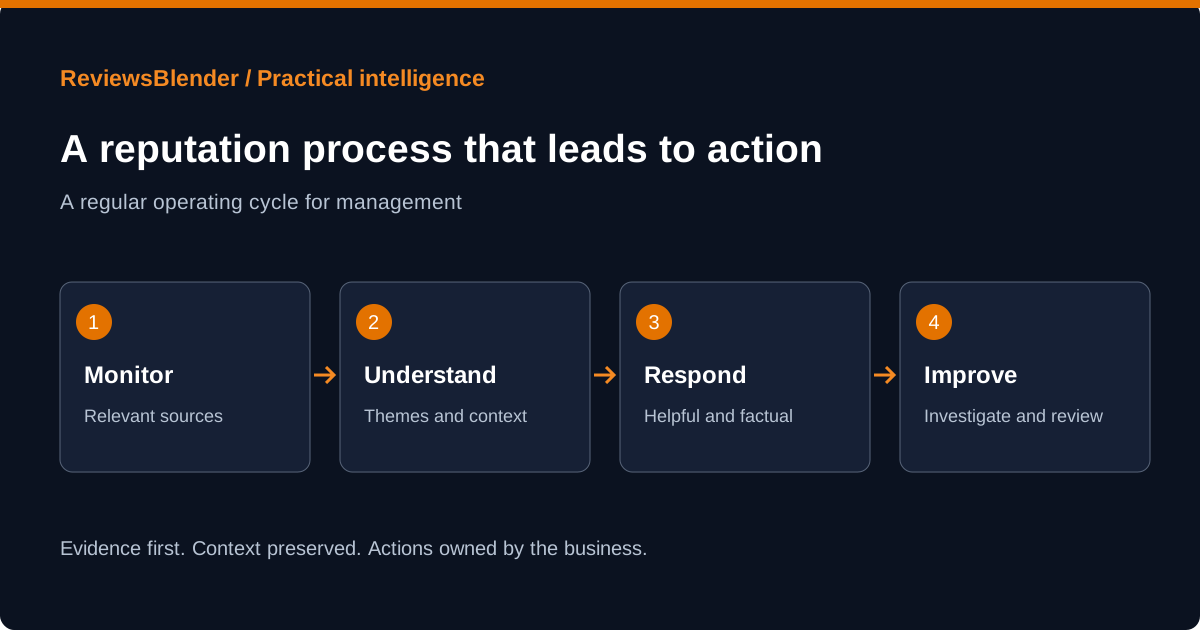
- Discover relevant profiles and check their business information.
- Monitor suitable feedback sources and record meaningful changes.
- Respond helpfully and route sensitive concerns to the right owner.
- Analyse recurring themes and retain the underlying evidence.
- Investigate operational explanations and implement appropriate changes.
- Review outcomes using suitable periods and measures.
Give different problems different responses
| Problem | Appropriate next step |
|---|---|
| Incorrect opening hours | Correct the authoritative business information |
| A genuine service complaint | Acknowledge it, investigate and offer an appropriate contact route |
| A suspected platform-policy violation | Document the concern and use the platform’s reporting process |
| A recurring complaint theme | Analyse the pattern and check operational evidence |
| A serious allegation or sensitive personal detail | Use the organisation’s responsible escalation process |
Negative feedback is not automatically a policy violation. Buying favourable reviews or offering incentives where prohibited can undermine both trust and platform access. Follow each source’s current rules.
Choose the right mix of monitoring and analysis
Social listening covers wider conversation; aggregation brings records together; review analysis interprets what they contain. A business can need more than one of these functions. See the category comparison for the distinctions.
ReviewsBlender focuses on review intelligence: AI-assisted, human-validated analysis and readable reports. For a business that needs a broad publishing suite, direct-response inbox or listings management, a suitable software platform may also be required.
Measure what the work changes
Track relevant source coverage, response quality, recurring themes and completed actions. Where commercial measures are used, record how they were obtained and what else changed. Do not attribute every movement in bookings or ratings to reputation activity alone.
Google describes relevance, distance and prominence in local ranking, and supports accurate information and helpful responses. It does not promise a fixed ranking gain for a particular response target.
Compare approaches in the small-business buying guide and inspect the report example.
Frequently asked questions
Is reputation management just responding to bad reviews?
No. It includes information accuracy, monitoring, response, analysis and appropriate operational follow-through.
Can a service guarantee better Google rankings?
There is no credible universal guarantee of search position. Assess the actual work, evidence and business outcomes instead.
Sources and further reading
- Google: improving local ranking
- Google: getting more reviews and replying helpfully
- About ReviewsBlender and editorial standards
External product and policy information checked on 1 November 2026. Product descriptions are vendor documentation; recommendations and interpretations are ReviewsBlender’s. Linked policies take precedence if they change.
Find out what your reviews are telling you
ReviewsBlender produces a human-validated intelligence report for $99 one-off, delivered within 24–72 hours. Ongoing monitoring costs $59/month and delivers weekly intelligence reports with review response suggestions. Coverage is checked for your business before analysis begins.
No setup fees. Cancel monthly monitoring any time. At least 3 actionable insights in your report, or a refund.